
“WCW killed itself. The cast of characters that was WCW killed WCW. It didn’t function as a team, it functioned as a bunch of self seeking individuals.” – Brad Siegel
“I’ve never seen anybody that was that high up in the food chain take less responsibility.” – the contemptible Kevin Nash’s reaction to the above quote in a statement so laced with irony, I nearly choked when I heard it
So, let’s take a final look at the suspects.
We have Hulk Hogan with a tanning bed in the weight room, Kevin Nash with a bottle of red in the wine cellar, Vince Russo with a booking sheet in the mancave, Eric Bischoff with a motorcycle in the ranch and Colonel Mustard with a pipe in the study.
Who killed WCW?
Obviously, the true answer, the correct answer is Jamie Kellner (or Turner management if you want to defocus slightly); he pulled the plug. But WCW was already dying, gutshot and sick, poisoned with it’s own effluents. Easy E himself built up the company to heights it had never seen… but his inability to move past Hogan as the answer to his woes, his empowerment of Nash, his inability to fight back when WWF recovered from the kicking he himself had administered… he helped tear down the very thing he had built. Hogan saw the place as a paycheck, an endless ATM that would never run dry. He never thought of anyone but himself and helped drain the place as much as anyone. Same with Nash, who looked at the camera with ZERO SHAME and claimed the lameness of a malfunctioning “bloodbath” was more damaging to the company than the infamous Fingerpoke of Doom. Russo? He didn’t kill the thing but he sure as hell didn’t help it. He merely poured salt into open wounds.
The bottom line is that, despite the AOL / Time Warner merger, which indeed was a terrible and truly cursed marriage from the get go, if WCW wasn’t in the miserable shape it was in, it wouldn’t have been sold. If it was still doing well in ratings (and it was doing… not great, but okay), if it wasn’t hemorrhaging money… AOL / Time Warner would have figured out a way to live with it.
I have no doubt Kellner hated wrestling. I have no doubt Turner folks were resentful of the programming and wanted it off of their airwaves. All of those things are true and in many cases, on record. Wrestling is seen as low class and low brow. I have no doubt that once the protection of Ted Turner was gone, things were a LOT different for WCW…
But none of that excuses the fact that the brand was bleeding money from everywhere. Huge contracts. Flying talent into every show, regardless of if they were booked or not. Concerts with KISS, appearances by Megadeth. Stunts. New sets. Pay per view deemphasized. Makegoods for ads on a promised third hour block of programming that no longer existed given away. Bischoff, in this final episode, hand waves the losses. “Oh, I’m sure there’s some truth to that [the expenditures and losses] but what people don’t understand is the WHY,” he says smugly, smirking into the camera. Oh, I dunno, chief, I think I can wrap my tiny, little mind around it.
The main thrust of this episode, beside absolving Bischoff of any culpability in the destruction of the wrestling company that made me into a fan, was laying the seeds of conspiracy. There is a potentially tantalizing hook, to be fair, if you are someone who is content with looking merely at the surface; a Turner executive, Stu Snyder, who knew Brad Siegel and was friendly with him, jumped ship and became a high ranking executive at WWF.
What’s the conspiracy, then? The idea being that Siegel somehow engineered the sale to WWF for pennies on the dollar of what it was worth with Snyder as the broker / intermediary as an inside job. An intriguing thought… which doesn’t hold up to scrutiny in the least. Bischoff, charged by Siegel himself to do so, searched for a buyer for WCW and put together a team of investors, led by Fusient Media, who, IN PRINCIPLE, agreed to buy WCW (more accurately, a majority stake; AOL / Time Warner would have still owned a small piece). They even held a press conference about it! Everything was done and all that remained was a signature on the bottom line from both AOL / Time Warner and Fusient… and then Kellner cancelled WCW. Fusient pulled out and WWF swooped in. Bingo, bango, bongo.
The real reason Kellner cancelled WCW? The fine print. Fusient put in… not a poison pill exactly, but a measure of protection in their contract with AOL / Time Warner. If WCW were to be cancelled, Fusient would still control the WCW time slot. Kellner, freshly in charge of these networks, couldn’t have a rogue element potentially controlling four hours’ worth of prime time without his oversight. That, coupled with his distaste for the nature of the programming, probably made pulling the plug a WHOLE lot easier.
None of this was mentioned, of course. Instead, we get ten minutes of Bischoff saying “I’m not saying there was a conspiracy, but boy it should would explain a lot of things!” wink wink nudge nudge. You know what else explains a lot of things? OCCAM’S FUCKING RAZOR. To the… ugh… credit… of the producers, they did flat out ask Siegel and Snyder about this and they both pointed out how ridiculous the idea was. Even Guy “I co-wrote Eric Bischoff’s biography” Evans pointed out that there would be an awful lot of laws broken and huge consequences if any of that were remotely true. That being said, the laying the groundwork of conspiracy, just enough to deflect blame, just enough to give a molecule of plausible deniability, was truly cowardly and possibly the worst thing this show managed to do.
If I were to praise this show for something, it would have to be the human element. Not the talking heads garbage, 90% of which was worse than useless, but the stuff like finding a crew member who took a home movie of the last day of Nitro and talked to some of the workers and crew. Stuff like THAT is valuable and deserves preservation. That’s where the human element of this show comes in, the realization that the death of WCW wasn’t just some wrestler moving from one place to another, but the destruction of a family of people who all worked together in a very unique business together, some since the 1980s. All those crew members, the guys who put up the ring, the cameramen, the technicians? WWF didn’t hire all of them or indeed most of them. Some of them folded into other jobs at Turner networks… and some of them did not; the WCW diaspora was not equally spread. The good things about this show are things like Neil Pruitt getting genuinely emotional when he described the best job he ever had dying 25 years ago at the hands of incompetents, not Eric Bischoff getting faux choked up over some mildly kind words from Kevin Nash.
The show closes, of course, since it was a stealth reclamation project, to what end I can only guess and will at the bottom of this column, with a contemplative Eric Bischoff, staring out at the mountains of his beloved Montana (or Wyoming or whatever), framed in golden light (NOT an exaggeration, I promise). He looks at us and, in the most cliched, trite final word, tells us that, looking back, it was a helluva ride and that he wouldn’t change a thing.
Let’s ignore all the times where he has said what he would specifically change. I guess.
Tripe. Awful, nearly unwatchable tripe. Eric ALL BUT ASCENDS INTO HEAVEN, FREE OF ALL SIN BY THE END.
To wrap up the personal part of all of this, since my examinations of this show have been just as much about my relationship to WCW through the years as it was the inaccuracies and horseshit, I can tell you that we had two people over on the night WCW died. It was my wife (then girlfriend) our roommate (just as wrestling crazy as we were) and a buddy of his (also a fan). We watched aghast as Vince McMahon appeared on Nitro. We groaned when the show kept cutting away to show McMahon trying to make out with Trish Stratus. We got emotional when Ric Flair cut his impassioned promo about how WCW was the best (which he retroactively ruined every time he talked about it, saying how happy he was the day WCW died). The matches were mostly a blur, all fast and set up for the babyfaces to triumph… and of course, Sting and Ric Flair battled one last time.
It was surreal, to say the least. The wife and the roommate carried on watching RAW for awhile. I dropped wrestling cold, other than starting to buy as much WCW as I could, be it through commercial means or bootleg DVDs of shows in bulk. We listed to the old version of Wrestling Observer Radio, where every caller was desperate to call this all a “work.” To who’s benefit would this be a work? Dimbulbed desperation, but I got it; I was desperate, too. I would look at XPW DVDs because they would have the likes of Konnan or Shane Douglas on them. WWF claimed to bring back WCW, failed to, and it turned into something very different; the Invasion, and we sat most of that out. We came back for a bit when they brought in the NWO and the wife and roommate started watching a little RAW and a touch of SmackDown but I still held it all at arm’s length. ROH happened. TNA happened. I didn’t get either; TNA not being available on my cable package, ROH being a bit too removed from my sphere of knowledge and comfort. I kept buying old WCW and NWA when I could, finding the world of “tape trading” (aka paying a guy to run you off copies of his videos). TNA eventually got on Fox Sports Net, and that I DID have on my cable package. I discovered ROH and Dragon Gate. I got into old puroesu. I started subscribing to the Observer. Eventually, I was all the way back in but it took a LONG time, four or five years before my fandom truly recovered from losing WCW in that abrupt way.
As for the last bits of WCW… of course WWF became WWE and ran the Invasion stuff, some of it wildly successful, some of it only so so. They managed to do the Invasion without any of the big, top names, and brought them all in eventually anyway as they were the only game in town. Eventually you had TNA and some of the WCW principles would make their way there, including a disastrous run with Eric Bischoff and Hulk Hogan nominally in charge.
Oops.
AOL / Time Warner was a disaster, of course, AOL being a huge albatross about Time Warner’s neck that they eventually divested themselves of. Ted Turner did apparently kick the tires on getting back into “rasslin’,” but was told the start up costs were too exorbitant to be truly competitive with the titan (pardon the word) that WWE had become with no real competition.
Various wrestling business that Turner could not divest itself of in the sale (lawsuits, contractual matters and the like) continued to be done under the name “Universal Wrestling Corporation,” surely relegated to a filing cabinet somewhere at CNN Tower. Through lawsuits and such, we begin to see the scope of the bloat WCW was eventually strangled by.
The former Power Plant continued to do business for a little bit as an independent wrestling school but folded. WWE eventually had Plant head Jody Hamilton (the Assassin, father of terrible referee Nick Patrick) open up a school for them under the moniker “Deep South Wrestling.” It didn’t go great, but Kenny Omega was there for a second, so that’s something.
Turner had a regional, satellite only TV channel called Turner South that they produced NEW WCW content for, post sale, called WCW Classics. The new content was largely just Dusty Rhodes at the Power Plant (or what was left of it) pitching to classic footage. This vestigial content doesn’t appear to be owned by WWE as it was produced post sale, completely without WWE involvement and even had Ric Flair on an episode, cutting promos and just being the Nature Boy. Dusty apparently absconded with some of the remaining Power Plant rings and paraphernalia when Classics came to an end. It’s not what you make, it’s what you save.
That’s pretty much it. Most of the WCW folks WWE didn’t want or couldn’t initially afford went to TNA or one of several other failed wrestling startups. EVERYONE was desperate to find those viewers WCW had that never came back, but no one figured out the formula to do it. Some bright bulbs, around the time of the ECW comeback, aired a pay per view called “The 6:05 Reunion,” which featured some former WCW folks and was sort of couched as a faux “WCW One Night Stand,” but largely just seemed like a shittier version of TNA. There are probably more words in this column than people who bought that show.
So was the rehabilitation of Eric Bischoff successful? I have no idea. Evan Husney was on POST Wrestling earlier this week, and when asked why there wasn’t more use of reporters, much like any episode of Dark Side of the Ring would have used, Husney said that he was afraid that no one could be objective enough and he didn’t want to let that stand in the way of his documentary. Take that as you will. I take that to mean they wouldn’t have had Bischoff’s participation if a Dave Meltzer or a Bryan Alvarez were part of the production, and therefore the production would not have had it’s desired effect. Cowardice. The only thing I can’t get out of all of this is what does the Rock (Eric’s “buddy,” by his own admission in the final minutes of the show) stand to gain from rehabbing Bischoff’s image?
A few years back, Dick Ebersol and Vince McMahon participated in a documentary about the failed XFL startup football league. The interest in the documentary led to explorations into starting up spring football again, including from McMahon himself. These attempts all failed, of course, and now, the Rock is part of an ownership group that has the remaining league; a merger of some of the assets of the XFL and an ersatz USFL called UFL (I think; I only truly care about FAKE sports).
Was all of this Bischoff washing and scrubbing and WCW praise some sort of attempt to gauge interest in another WWE led brand, this time from the “fertile” mind of the Rock, this time playing in his mother’s world of promotion instead of his father’s world of the squared circle? Will the Big Boys play again?
If this horrible documentary is any indication, I hope the answer to that is a resounding “no.”
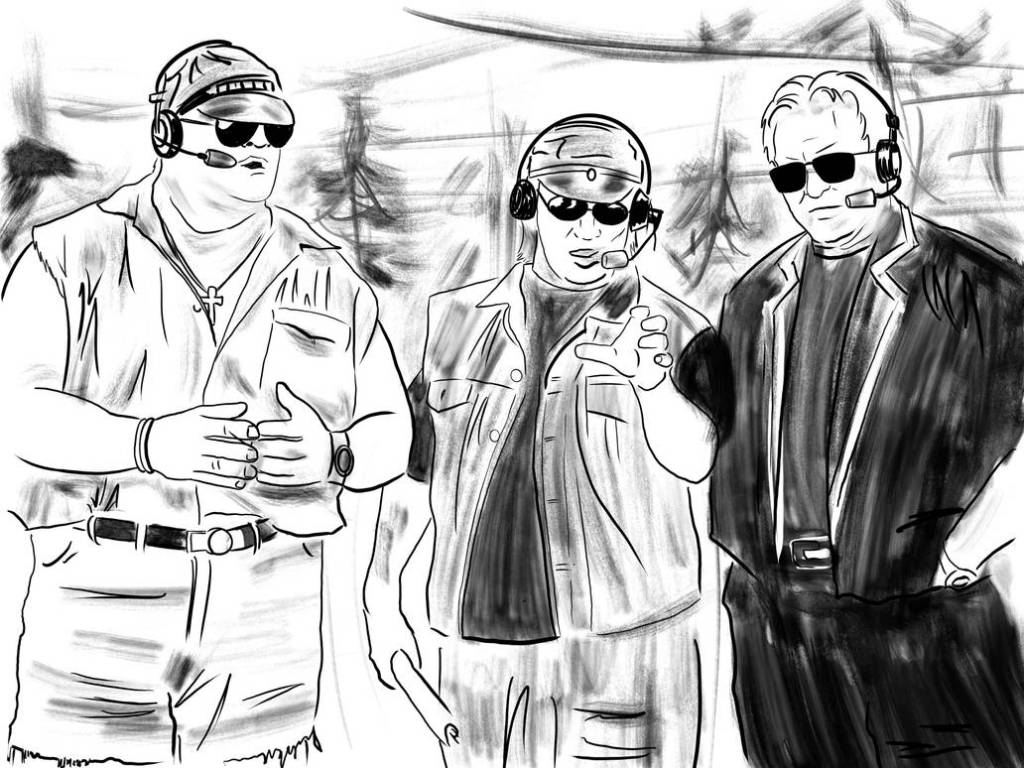
The boys going Hog Wild seemed an appropriate way to end this look back at something I loved and was destroyed by negligence and greed


 La Zona Muerta
Leave a comment