
“I wanna be Jim’s Shooter!” some ‘clever’ wag in fandom said once in the 80s. HA HA GOT ‘IM. Cool way to enjoy comics, bro.
There was a LOT of vitriol around Jim Shooter then in those times (and certainly extending into the 90s as he launched several failed publishing ventures), some of it warranted, some not. We, you and I, will NEVER know the exact amount of what was earned anger and what was misplaced jealousy in regards to Shooter… at one time, one of the most powerful men in comics… we can only experience the accounts of others and look for patterns, reoccurring issues.
Gary Groth of the Comics Journal and Fantagraphics (in)famously called Shooter “Our [the comics industry’s] Nixon,” and, if I recall correctly, likened him to a Nazi collaborator due to his role in the Marvel returning Jack Kirby artwork controversy. No matter who you are, no matter how tough your skin is… that sort of thing HAS to take a psychic toll.
Shooter was a big man, a ‘large mammal,’ according to his sadly short lived blog. It’s perhaps fitting that he contained so many facets.
Child virtuoso.
Hero.
Villain.
Pariah.
Boss.
Tyrant.
Victim.
Which is true? Which is correct? All of those appellations? None? Shooter is no one thing. To misquote Walt Whitman, “he was large, he contained multitudes.” I will say this… if we strip away some of the controversies… as Marvel editor in chief alone he:
- began the royalty program that made a LOT of your favorite comics creators wealthy or made it so they could actually approach comics as a living
- shepherded the development of cats like Frank Miller and Bill Sienkiewicz
- was at least, if nothing else, the watchful editorial eye over runs like the best years of Chris Claremont’s Uncanny X-Men, Walt Simonson’s Thor, both Frank Miller runs on Daredevil, the David Micheline / Bob Layton / John Romita Jr. Iron Man, Roger Stern’s Avengers and Spider-Man, the Official Marvel Handbook, the best years of Larry Hama’s GI Joe, John Byrne’s Fantastic Four… all rightfully considered classics
- helped bring EPIC Magazine and later the actual EPIC Comics line to life, and started the Marvel Graphic Novel program and format
- And that’s saying nothing of his OWN creative work, his runs on Avengers, Secret Wars and Secret Wars II (okay, II decidedly less heralded than the first one), the bizarrely personal Starbrand…
- He personally came up with most of the recognizable backstory to something that I love as much or even more than comics… the backstory for Hasbro’s Transformers. Yes, he had the help of Bob Budiansky and others but the treatment of Autobots versus Decepticons battling over the remains of resource poor Cybertron? The basic storytelling engine that would last for forty years?That’s ALL Shooter
And that’s pretty much the tip of the iceberg. That’s really not saying much about assembling a killer editorial line up (the likes of the aforementioned Hama, Al Milgrom, Ann Nocenti, Carl Potts, Mark Gruenwald, Denny O’Neil, Archie Goodwin, etc.), getting the trains at Marvel running on time (Marvel was a mess in the 70s, lurching from one editor in chief to the next and Shooter was eventually chosen as very much a neutral party as to not upset various office factions… thereby making ALL of them mad) or just generally concentrating on putting out BETTER comics. NONE OF THAT is even scraping the SURFACE of his work at DC comics… which he began as a FOURTEEN YEAR OLD BOY.
Let THAT one sink in for a second. That’s something where you assume someone is fudging or not telling the whole truth… and then you see Curt Swan sending Jim a personal letter about how much he enjoys his scripts and layouts. THIS FOURTEEN YEAR OLD KID DID LAYOUTS FOR CURT FUCKING SWAN TO FOLLOW. Can you imagine what that must have been like?
None of this is to say Shooter was perfect or even some kind of maligned hero. The controversial Avengers issue #200 alone would probably put paid to that line of thinking… a tone deaf write off of the heroine Ms. Marvel (the less said about the better… let’s just say it involves the most twisted immaculate conception possible) that was so dire Chris Claremont wrote a RESPONSE COMIC (like a dis track!) about it in the pages of Avengers Annual #10. Shooter was one of those involved in both the plotting and indeed the buck stops here boss in the case of Avengers 200 (many years later, he admitted that he should have never published it). There was the absolutely baffling story he wrote for the Hulk Magazine, allegedly pulled from a real life experience of his own, where Bruce Banner is nearly raped (!) by predatory gays (!!) at the YMCA (!!!)… apparently because Shooter wanted the magazine to explore more ‘mature’ themes. Shooter wrote the issue of Avengers where Hank Pym backhanded his wife, Janet Van Dyne, an event the character has NEVER been able to shake despite the efforts of creators no lesser than Roger Stern, Steve Englehart, John Byrne and Kurt Busiek. Shooter devoted the ENTIRE FIRST ISSUE of the company’s guaranteed cash cow, Secret Wars II, to making fun of legendary writer, curmudgeon and part time crackpot Steve Gerber, for no reason other than payback over a bad experience involving Gerber’s return to Marvel. Shooter wrote New Universe anchor title Starbrand (we’ll get into it), a series so startlingly personal that it’s almost embarrassing to read. Creatively, he was no more immune to missteps or flat out misfires than any of his contemporaries.
Then, you had the exodus of talent. Roy Thomas left. Marv Wolfman. Gerber (although the wheels on that were in motion before Shooter took the helm). Gene Colan. Doug Moench. George Perez famously had a falling out with Marvel (despite him already working for DC). Marvel and DC famously severed their co publishing venture over Shooter’s delays and objections to DC’s handling of the JLA /Avengers crossover. Was this all Shooter’s fault?
It’s a mix, like anything. Some people want to hang that black hat on Shooter and make him responsible for EVERYTHING. Some of those names? Yes, he 100% drove them away. Some of them had one foot out the door. Everything isn’t always perfectly black and white.
There definitely came a time at Marvel where the bad of Shooter, the inertia, the weight he brought to things outweighed making the trains run on time, outweighed the good he had done. A LOT of people seem to place this tipping point around the time of the publication of Secret Wars II, the follow up to the MASSIVELY successful all company crossover Secret Wars. For better or worse, Shooter created and popularized the company crossover, books having to tie in for two or three months to an ‘event’ book as a spine. Secret Wars itself began as a toy tie in for Mattel but wasn’t treated as a mere toy tie in title, swiftly becoming it’s own monster, a massive, epic throw all the toys into one giant sandbox crossover that had actual repercussions on Marvel continuity. A sequel NEEDED to be be created and Shooter went straight to work… creating something… a LOT different. I’ll cop to it, I ENJOY Secret Wars II for the most part, but it certainly is a bit repetitive (the foreign god known as the Beyonder comes to our universe, seeking understanding and has various blunders along the way as he sinks into depression and rage). The book ends bizarrely, the Beyonder killing himself (well, his mortal self) over and over (!), feeding his prodigious life energies into a machine that produces (emphasis mine), a NEW UNIVERSE. Shooter has said this had NOTHING to do with the launch of Marvel’s publishing imprint NEW UNIVERSE, but for ME, it’s IMPOSSIBLE to read this as anything else. The Beyonder gives of himself and creates the New Universe, Marvel’s self sabotaged 25th anniversary publishing project.
The New Universe is another albatross people try to tie around Shooter’s neck, but I think it’s safe to say that Marvel bean counters probably can lay claim to the lion’s share of the blame in the failure of the line. In brief, there was meant to be a publishing stunt to celebrate Marvel’s 25th anniversary. There was no consensus editorially what this 25th anniversary stunt could be (Shooter allegedly floated a Marvel reboot, a rumor that had dogged his heels for years. I think there may have been some truth to it initially when the rumor first came up; I believe the idea was plainly laid out by a disgruntled Doug Moench when he left the company and the negative fan pushback probably scuppered the idea) and eventually, there was a half hearted decision to start a new line of comics, one that supposedly would have less fantastic elements and be a bit more consistently designed from the ground up than the original Marvel Universe had been. Publishing budgets and creatives were attached… and then budgets were slashed and creatives were lost. There were still good creators but there were also a lot of first timers and untested talent, too. Eventually, the line became what we know as the New Universe, a series of neither fish nor fowl comics with unusual experiments into real time storytelling, allegedly more grounded, more “world outside your window” settings. Weather or not any of these experiments were successful is up to the beholder… but by the time Shooter was fired, the line was cut back severely. The entire publishing venture lasted less than three years. It’s a fairly infamous Marvel failure.
But Jim wrote Starbrand, the flagship New Universe title. Starbrand, a Green Lantern / Lensman type riff about a tall, philandering Pittsburgher (!) who gets the powers of a dead alien through a special tattoo / mark / brand on his hand… and proceeds to fuck up his own life, the life of his prospective girlfriend and the life of the apparently differently abled other woman he kept around as a side piece / safety net.
WHAT THE HELL WAS THIS? ARE KIDS SUPPOSED TO READ THIS?
This is the strangest book and every so often it comes up for critical reassessment. It is so startlingly personal that you can’t help but cringe as you read it, especially when you realize the main character is a self insert for Shooter. THE MAIN CHARACTER IS NAMED KEN. SO IS SHOOTER’S FATHER. He’s a slacker dork from Pittsburgh, never sure about where he’s drifting in life. Ken openly sees a psychiatrist (who knows about his powers) and wonders about why he should maintain his dead end job at the local auto garage when he could be out there blowing up Khadafi or whatever. He openly uses his powers to peep on his possible girlfriend (!!!) and whines when she dates others while he has his own built in relief valve, a woman so devoted to him that she THREATENS TO KILL HERSELF when he tries to break it off with her. “I don’t care if you get married… just… just come and see me sometimes, like always. OR I’LL DIE. I’LL SIMPLY DIE.” The sexual politics in this book were, uh… sophisticated, to say the least.
A LOT of this strangeness would be refined into SOLAR, Man of the Atom when Shooter launched VALIANT, but we’ll get there, too.
Man, I didn’t expect to write this much but the words keep coming.
Shooter, at this time, was pretty much public enemy number one in the fan press. The Comics Journal definitely led the way, there, and Shooter was no saint. A blunt man, a company man forged in the fires of the genuinely evil DC editor Mort Weisinger from the age of 13 onward.* A guy who would send ‘comedy’ memos saying things like “Editors: Effective immediately start doing GOOD comics. I realize that this directive reflects a substantial departure from previous company policy, but please try to comply.”
Good heavens.
Shooter, for better or worse, was the face behind the Jack Kirby art return controversy. Was that fair to hang on his neck? I’m not sure. I’ll put it another way; no, it wasn’t fair but Shooter sort of accepted that he had to be the face of it. I’ll try to be super succinct here; Marvel kept art from ALL of it’s artists in a ridiculous, barely inventoried set up in a leaky warehouse somewhere in a dangerous part of New York. Art would go missing all the time (if you ever want to change your mind about a giant like Gil Kane, maybe follow THAT particular rabbit hole a little). Eventually Marvel started a return policy, but it had draconian elements to it… to get your work back, you had to sign off on something that said you had zero rights to your work and that Marvel was ‘gifting’ you the artwork back. When Roy Thomas was editor in chief, he set it up so writers, artists and inkers would get a share of their work back. Shooter eventually changed this to just artists getting the art back, thereby upsetting writers. Go figure.
Anyway, Kirby got work back like everyone else at this time… but then the matter came up of the possibly tens of thousands of pages he had drawn in the 60s for the company, art created before the the art return policy was put in place. This always gets turned into “Jack Kirby sued Marvel,” and that was never the case. There was definitely legal saber rattling on both sides, but eventually both sides hammered out an agreement and Jack got (some of… allegedly a tenth of) his art back. But the face of this ongoing struggle was Shooter. Always Shooter.
Then you had the other various controversies. The aforementioned JLA/Avengers fiasco (I genuinely don’t think Shooter was at fault, there, and other key players of the time back that up). Shooter’s fairly staid, conservative way of making comics (unless you proved to him you could follow the rules… and then you could BREAK them, like a Miller or a Sienkiewicz). His blunt dismissal of various talent. His interference with proven talent, particularly after the success of Secret Wars II (this seems to be where Shooter and John Byrne’s relationship completely fell apart; unwanted editorial interference of Byrne’s Fantastic Four. The late, great John Romita was quoted as saying more than once that after SW II, Shooter could not be argued with). Shooter and his interoffice issues with his second in command, Tom DeFalco. Shooter’s interoffice issues with EVERYONE by the time of the sale of Marvel Comics to New World Pictures. Basically, (most of) the editorial staff outright said Shooter goes or we do. Shooter saw this as a coup while he was fighting to save creator’s rights from the new owners. It’s something that again, those of us on the outside will never fully know the full truth of.
Shooter was gone from Marvel Comics by mid 1987. Apparently, and according to him, so take it with a grain of salt, he put together a capital investment group that nearly BOUGHT Marvel outright but lost out to professional corporate shark Ron Perelman. When that capital investment group failed to buy Marvel, they instead put together something called Voyager Communications, Inc. and Voyager’s publishing arm would eventually be known as VALIANT (all caps, all the time). VALIANT got its start (against Shooter’s wishes) publishing Nintendo and WWF tie in comics before they finally were able to license two old Gold Key Characters… Dr. Solar and Magnus, Robot Fighter. With these two books as his base, Shooter launched a carefully curated superhero line, mostly written by him, definitely all ‘show run’ by him, presenting a fairly unified and unique series of books with a mix of veteran talent, talent on the outs with Marvel for various reasons and fresh kids out of the Joe Kubert School or even just off the street, pretty much, called ‘Knobs.’
The bizarre premise of Starbrand, a slacker loser becoming the world’s most powerful man, was refined and became the basis for SOLAR, Man of the Atom, a book where a man becomes, quite literally, God. A guilt ridden, nearly schizophrenic God.
It’s a genuinely good book, free of the self insert aspects that make Starbrand tough to swallow. Still has the bizarre comedy relief psychiatrist, though.
Magnus, Robot Fighter hewed a little closer to the path of the original Russ Manning Gold Key series but immediately ratcheted up the tension and unchanging setting of the original as Magnus slowly becomes an outlaw, taken for granted by a coddled future society. Also good stuff.
Shooter dusted off a screenplay he had written and created HARBINGER, a story about mutant teens on the run from the possibly evil HARBINGER corporation, led by the pragmatic Toyo Harada (a tiny drop of late 80s Japanophobia, perhaps?). Harada was largely the secret mover and shaker behind the scenes in nearly every VALIANT book. The line grew quickly; XO Manowar (picture Conan in Iron Man armor). Shadowman (picture a jazz musician who gets powers at night). RAI, a book set in Magnus’ future of 3001 AD about the spiritual guardian of Japan. And somehow? These books all tied together, not in a way that made you be on the hook as a reader, but in a way that REWARDED you reading the other books. Shooter’s swan song at VALIANT was an entire line wide publishing event (remember those?) called UNITY, which brought all of the disparate characters together in a war against a nearly omnipotent woman (an incredibly flawed and complicated character, sexually abused and becoming an abuser herself before deciding that in order to save herself, all of creation had to be restarted. More weird sexual stuff in Shooter’s work) from the pages of SOLAR.
Pretty heady stuff.
THe wheels fell off, because of course they did. Shooter’s partners in VALIANT, according to him, sold him out, fairly literally. Two members of the board began an illicit relationship and essentially strong armed Shooter out of the company. Is this true? Did Shooter get the shaft yet again? Yes, I believe it to be so. Unfortunately, this is where you start getting Jim Shooter: Victim and some people were just not willing to have sympathy for a pariah.
Shooter next founded DEFIANT publishing (with a self aggrandizing trade ad in the form of a comic alluding to Shooter’s various dealings with bad guys in the comic industry but somehow, throughout the betrayals, he was still standing DEFIANTLY), and took the people loyal to him from VALIANT as his core of creators. DEFIANT had some promise, some neat concepts (the main book was Warriors of Plasm, a sci fi weirdoverse full of living planets and people who were likely to say things like “Ah, more gore for the Org, my lust-mate!”) but a protracted legal battle with Marvel 100% designed to drain his coffers, coupled with partnering with a greedy financial backer who insisted that the first issues of the main two DEFIANT comics be published as TRADING CARD SETS, coupled with the collapse of the North American comics industry meant that DEFIANT didn’t see more than two years before shutting down.
Shooter landed somewhat on his feet and somehow hooked up with Lorne Michaels of all people, who was looking to launch a publishing imprint through his own company of Broadway Video. Broadway Comics was born, and was another fairly interesting publishing venture (more so than DEFIANT, in my opinion) where Shooter became a showrunner and wrote books with a team of writers (including loyal Shooter lieutenant Janet Jackson. NO, not THAT Janet Jackson) almost the way TV shows are written, with a strong emphasis on female writers in the room. Also a strong emphasis on cheesecake comics but… you know, swings and roundabouts. Broadway failed utterly to make a blip in the fallout of the NA comic collapse. VALIANT was bought by Acclaim (yes, the video game publisher) for over $60 million dollars, money that Shooter was aced out of. Shooter would continue to make comics here and there (a lot of stuff you’ve never heard of, a lot of custom jobs) and DC even brought him back for almost two years on his signature title, the one he wrote when he was thirteen, Legion of Superheroes, but he had a miserable time on the book, often clashing with DC editorial. He was opinionated and had no problem telling the main artist on his book that he was a good artist but a bad storyteller, and that of course did not enhance Shooter’s rep any.
Shooter returned to the Gold Key characters once licensed to VALIANT for a time (Magnus, Solar and others who didn’t make the grade like the Mighty Samson) in the 2000s before finally quietly doing other things with his time. I REALLY wish he had written a tell all biography; I have plenty of interviews with him and despite his definite penchant for casting himself as the hero in most of his personal stories (hey, don’t we all), he was a part of SO MUCH comics history that a book, even if it were half fiction, would have been an incredible read. I’m bummed we’ll never see that now.
In the end, was Shooter a villain? I can certainly see why people would cast him that way. Did he deserve the figurative stake burning people like Gary Groth subjected him to (or the LITERAL effigy burning John Byrne subjected him to? Of course I’m not kidding)? I believe the answer there is ‘no.’ Shooter was flawed. Complicated. He was also the shepherd of so much work that means something to so many of us. His influence in comics is still felt today, thirty, forty years past his relevance as a creator or editor or power broker. His controversies tend to overshadow his actual work, 90% of which was really solid and probably deserving of critical reassessment. If any of what I’ve said sounds interesting, I would definitely recommend seeking out his blog (find it before it’s lost forever; he stopped updating in 2012) and of course his work on Avengers, LoSH, his VALIANT stuff, even the highly weird Starbrand.
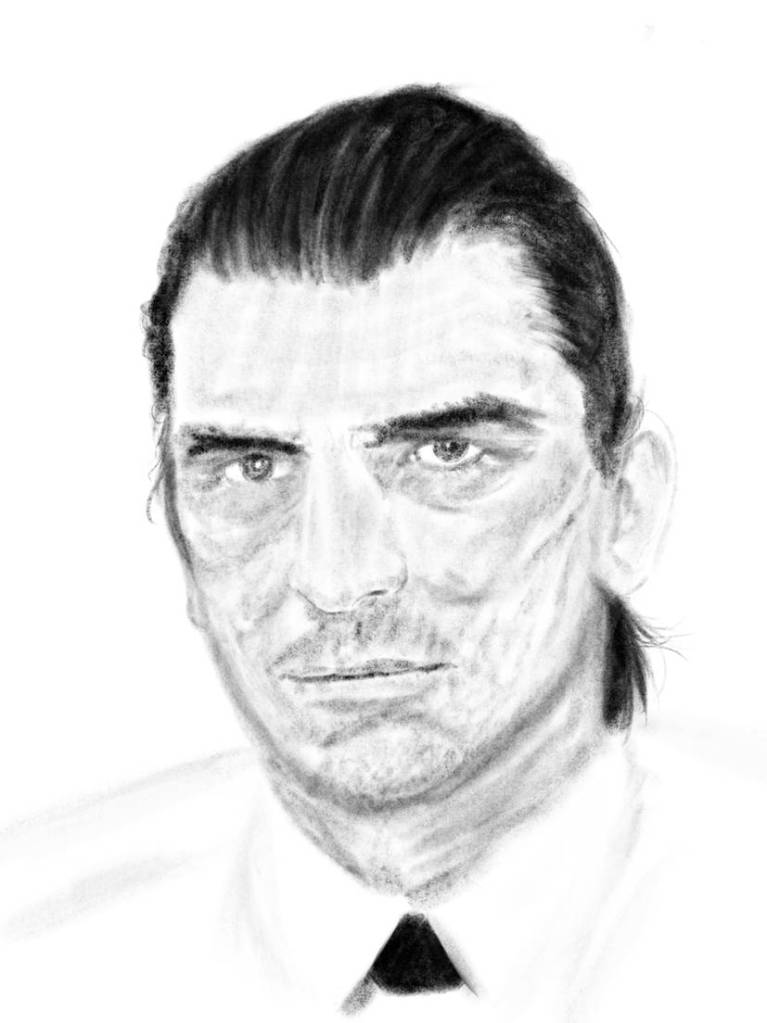
After Fantagraphics cancelled Amazing Heroes, the more superhero-centric companion to the Comics Journal, an outfit called Spoof Comics copyrright squatted licensed (maybe) the rights to the name and put out a few interviews under the AH name. One issue in particular has a scary photo of Shooter that’s lived in my noggin for thirty years. I tried to capture it as best I could with faux charcoals, here. Note the 90s power ponytail my man had. Ah, corporate life
*Although Shooter was a literal child and somehow doing well enough to make sales to his editor, Weisinger would spend hours berating Shooter over the phone and telling him that the other writers in his stable were so much better than him. Then Weisinger would turn around and tell his other writers that they were all on the verge of being fired because Weisinger had wunderkind Shooter in his back pocket. The life of a freelancer, amirite

 La Zona Muerta
Leave a reply to Ben Herman: In My Not So Humble Opinion Cancel reply